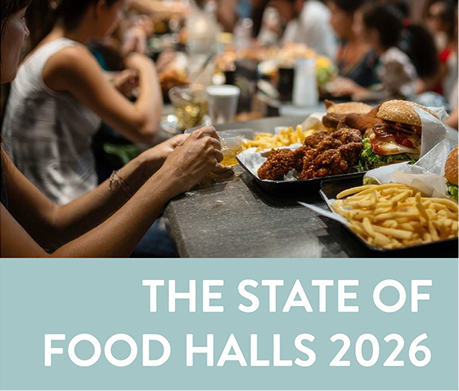

For developers, investors, and operators, one question continues to shape the future of mixed-use projects: Can a food hall serve as a true real estate anchor?
The answer is increasingly yes—but not in the traditional sense.
Unlike a grocery store, department store, or movie theater, a food hall does not create value solely through rent payments or square footage productivity. Its impact is broader and often more strategic. The best food halls drive foot traffic, increase dwell time, support leasing momentum, activate multiple dayparts, and transform how people engage with a property.
In other words, a food hall’s greatest contribution is not what happens within its four walls. It is how it improves the performance of everything around it.
According to industry leaders at the Future of Food Halls conference, an anchor is defined by its ability to change visitor behavior.
“To me, that’s what an anchor is: something that changes who is coming through, why they are coming through, and what time of day they are coming through.”
— Chris Viola
This definition captures why food halls have become so important in modern real estate.
A successful food hall:
Rather than serving as a passive amenity, the food hall becomes a dynamic placemaking engine.
Developers are increasingly incorporating food halls into:
The rationale is simple: people gather around food and beverage.
When thoughtfully designed and professionally operated, food halls can generate energy that benefits every component of a property, from apartment leasing and office occupancy to surrounding retail and event revenue.
Leasing a large space does not automatically create anchor value.
A food hall becomes an anchor when it meaningfully changes how people use a property. The most important questions for developers are:
A visually impressive space that lacks programming and operational discipline may fill square footage without moving the metrics that matter.
Food hall economics should not be judged solely by direct rent or revenue. Their impact often appears in broader property performance indicators, including:
As Nick Freshman noted, the term “anchor” should mean more than economic value alone. The best food halls become “true placemakers” that strengthen both community identity and real estate performance.
One of the biggest risks in food hall development is misaligned expectations. Food halls often require time to stabilize. They need:
If landlords expect immediate returns comparable to traditional retail, frustration can follow. Michael Morris emphasized the importance of quantifying results. Operators must be able to clearly demonstrate the value they create through traffic, events, beverage sales, and tenant performance.
A food hall does not become an anchor by simply opening its doors. Programming is what converts a collection of food vendors into a destination.
Examples include:
Morris described bar operations and events as two of the most controllable levers for generating foot traffic and profitability. For developers, this is a critical insight: the value lies not just in the tenant mix, but in the operator’s ability to continuously activate the space.
Food halls succeed only when their vendors succeed. Operators should closely monitor metrics such as:
Morris shared a practical benchmark for occupancy costs:
This level of visibility helps operators identify struggling vendors early and maintain a healthy ecosystem.
When food halls perform well, they can create measurable benefits across an entire development:
To understand whether a food hall is delivering anchor value, stakeholders should monitor:
These indicators provide a fuller picture than rent alone.
As mixed-use projects evolve, food halls are becoming strategic infrastructure rather than optional amenities. They combine hospitality, retail, entertainment, and community activation in a single operating model. For developers, that means underwriting more than rental income. For operators, it means proving value beyond food sales. For investors, it means recognizing that a well-run food hall can materially improve the performance of the surrounding asset.
The strongest food halls do not become anchors because they occupy space. They become anchors because they activate it. When paired with thoughtful programming, disciplined operations, and healthy vendor economics, food halls can drive foot traffic, increase dwell time, support leasing, and transform a property into a destination people return to again and again.
The most successful food halls are built on more than great design and strong vendor curation. They rely on technology that gives operators visibility into vendor performance, streamlines guest ordering, automates vendor payouts, and helps activate the space through events and beverage programs.
GoTab’s Food Hall POS platform is purpose-built for multi-vendor environments, with tools for centralized reporting, vendor management, shared tabs, self-ordering, and seamless payment distribution.
Learn how GoTab helps food hall operators create better guest experiences while maximizing the value of the entire asset.
The conversation continues.
Sign up to be the first to hear when we announce the dates for next year’s Future of Food Halls conference. You’ll also receive our free post-event playbook, featuring key takeaways, operator insights, and practical strategies shared by the developers, operators, and industry leaders who joined us this year.
Whether you’re planning a new food hall or looking to improve an existing one, it’s a valuable resource for understanding what’s working across the industry today.
Join the mailing list to get the announcement and download the playbook.

.jpg)
.jpg)
.jpg)
.jpg)

.jpg)