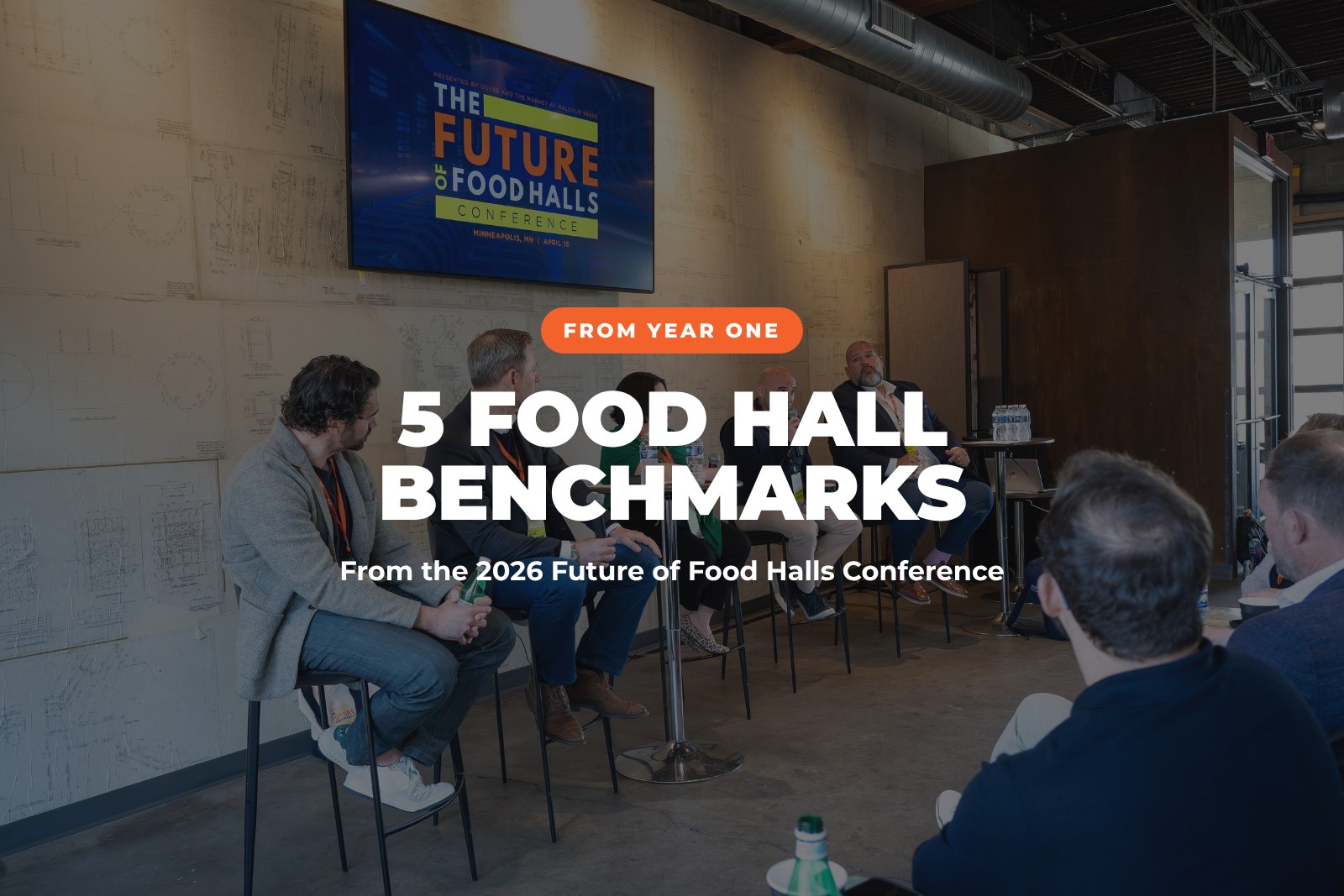
At the 2026 Future of Food Halls Conference in Minneapolis, nearly 30 operators, developers, designers and technology leaders shared the numbers they actually run their halls by. Michael Morris of Cana Development set the tone on his panel, naming the two biggest mistakes he sees: “letting vendors choose their own POS” and “giving up control of the bar.”
Those conversations became The Future of Food Halls: 2026 Report. Here are the five benchmarks operators kept coming back to.
Vendor health is an early-warning system. When occupancy costs eat too much of a vendor’s sales, turnover follows, guests get fewer choices and the hall loses its pull. Dwell time is the other lever: beverage programs, keg cocktails, self-pour walls, events and line-free reordering all keep guests around longer.
“The most successful food halls are finding the balance between operational consistency and constant evolution,” said Chris Viola, founder of Culture Collective Hospitality.
For the full breakdown, read 5 Food Hall Benchmarks From the 2026 Future of Food Halls Report on GoTab’s blog.
The second Future of Food Halls Conference is March 15–16, 2027, at Rembrandt Yard in Boulder, Colorado. Expect sessions on vendor health and rent structures, placemaking and design, and the systems behind multi-vendor operations, plus opening night at The Golden Mill and a Day Two lunch at Rosetta Hall.
Year one sold out. Early-bird tickets are $395 through Nov. 30.
Under 20% of a vendor’s sales. Between 20% and 23% is a caution zone, and past 23% to 24% calls for intervention.
In many cases, approximately 26% of guests drive nearly 62% of total revenue, so programs that keep guests longer pay off.
March 15–16, 2027, at Rembrandt Yard in Boulder, Colorado. Early-bird pricing of $395 ends Nov. 30.